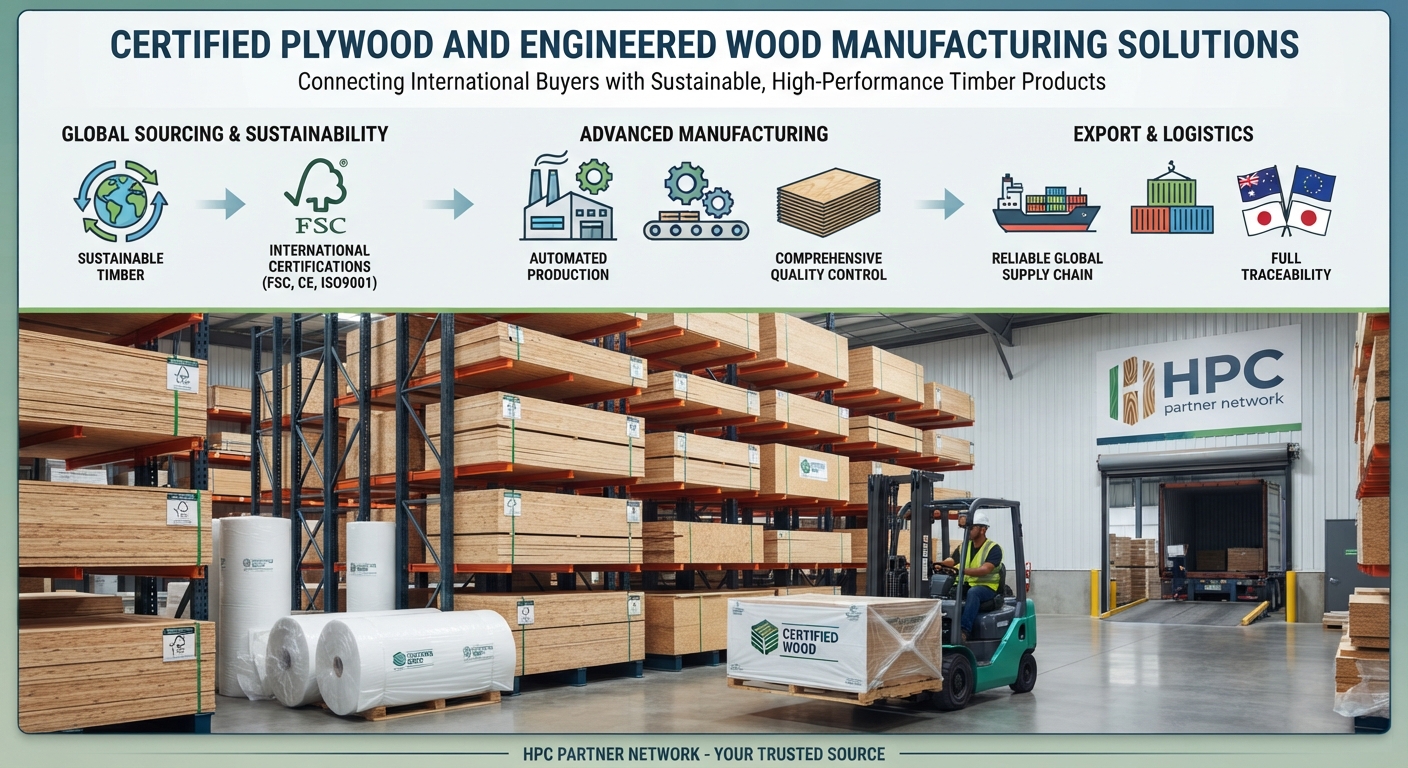
Procuring sustainable timber and certified plywood products for international construction, furniture manufacturing, and civil engineering requires reliable manufacturing partnerships. Through our trusted HPC partner network, global buyers, importers, and contractors gain direct access to full chain wood manufacturing capabilities backed by decades of craftsmanship and rigorous international certifications.
Discovering Our Comprehensive Plywood and Engineered Wood Range
Advanced building projects and commercial fit outs demand specialized wood products engineered for structural integrity, moisture resistance, and precise dimensional stability.
Plastic faced and structural formply panels deliver bending strength, waterproof protection, and smooth concrete finishes for major construction sites and bridge building.
Radiata pine, hardwood exterior, and marine grade plywood offer durable performance for exposed architectural applications, boat building, and external environments.
Specialized melamine boards, hex pattern non slip flooring, and laminated veneer lumber provide versatile solutions for internal cabinetry, shopfitting, and high load structural framing.
Benefiting From Integrated Supply Chains and Advanced Manufacturing
Maintaining consistent product quality across large scale international orders requires automated production systems and comprehensive material traceability.
Modern facilities spanning over 50000 square meters utilize automated production lines to yield an annual output exceeding 100000 cubic meters of certified wood products.
Global material gathering combines selected international timber imports with high quality domestic core veneers, ensuring full traceability from origin to end product.
Strict quality control protocols, experienced technical teams, and multi layered management systems guarantee reliable delivery performance for overseas partners.
Ensuring Global Compliance and International Standards
Meeting diverse regional building codes and environmental regulations is essential for successful import operations across global markets.
Comprehensive product series comply with major international benchmarks, including AS/NZS 2269, AS/NZS 6669, BS1088, JAS, CE, and ISO9001 standards.
Environmental responsibility is prioritized through FSC certification, sustainable wood utilization, and advanced manufacturing practices.
Products are exported extensively to Australia, New Zealand, Europe, Japan, Southeast Asia, and the Middle East, supported by a philosophy centered on integrity, quality, and mutual growth.
Frequently Asked Questions (FAQs) for Ghana Buyers
1. How can Ghana buyers access certified plywood manufacturing through HPC?
Ghana buyers gain direct access to full-chain wood manufacturing capabilities and certified timber products through our trusted HPC partner network.
2. What types of formply panels are available for construction projects across Ghana?
Our network supplies plastic-faced formply and structural formply panels designed to deliver bending strength and smooth concrete finishes.
3. How do structural formply panels assist major civil engineering projects in Ghana?
Structural formply panels feature high structural ratings such as F14 and F17, making them ideal for concrete formwork and bridge building.
4. What waterproof features protect plastic-faced plywood during Ghana concrete pouring?
A high-temperature bonded PP film provides outstanding waterproof protection, preventing moisture penetration and minimizing swelling rates during concrete pours.
5. How do radiata pine plywood panels perform in outdoor Ghana applications?
Radiata pine panels use high-grade veneer facings and durable A-Bond glue lines, making them fully suitable for exterior exposure.
6. What core materials are utilized in manufacturing hardwood exterior plywood for the Ghana market?
Hardwood exterior plywood uses durable hardwood species combined with A-Bond glue lines to withstand demanding outdoor environments.
7. Where is marine-grade plywood typically applied in Ghana projects?
Marine plywood features AA-grade faces and is ideal for boat building, lightweight joinery, wall linings, and ceiling finishes.
8. What quality standards govern marine plywood supplied to Ghana buyers?
Marine plywood is manufactured in strict accordance with BS1088 standards to ensure superior lightweight veneer quality.
9. How do melamine boards enhance internal cabinetry and joinery for Ghana properties?
Melamine boards feature clean, hardwearing surfaces bonded to both sides of high-quality plywood, making them perfect for drawers, shelves, and cabinets.
10. What moisture-resistant options are available for melamine plywood in Ghana?
Clients can select between standard (STD) types and high moisture-resistant (HMR/MR) variants depending on project humidity requirements.
11. How does hex plywood prevent slip hazards on industrial Ghana sites?
Hex plywood combines durable hardwood with a rugged exterior laminate pattern to ensure a tough, slip-free walking and working surface.
12. What structural benefits does laminated veneer lumber (LVL) offer Ghana builders?
LVL eliminates natural timber defects like knots and cracks, providing superior bending and compressive strength compared to solid wood.
13. Can laminated veneer lumber dimensions be customized for Ghana buyers?
Yes, the length, thickness, and width of LVL timber can be fully customized according to precise project requirements.
14. What manufacturing capacity supports Ghana orders through HPC?
Modern manufacturing facilities span over 50,000 square meters with automated production lines yielding an annual output exceeding 100,000 cubic meters.
15. How is material traceability maintained from forest to finished plywood for Ghana clients?
Global material gathering combines selected international timber imports with high-quality domestic core veneers, ensuring full traceability from origin to end product.
16. What quality control protocols ensure reliable delivery for Ghana partners?
Strict quality protocols, dedicated technical teams, and multi-layered management systems guarantee operational efficiency and dependable delivery performance.
17. Which international certifications validate the quality of plywood supplied to Ghana?
Products comply with major global benchmarks, including BS1088, CE, and ISO9001 standards, alongside regional certifications like AS/NZS 2269 and JAS.
18. How do manufacturing partners demonstrate environmental responsibility for Ghana imports?
Environmental stewardship is prioritized through FSC certification, sustainable wood utilization, and advanced eco-friendly manufacturing practices.
19. To which global regions, including Ghana, are these certified wood products exported?
Products are exported extensively to Europe, Ghana, Australia, New Zealand, Japan, Southeast Asia, and the Middle East.
20. What core business philosophy guides our manufacturing network for Ghana transactions?
Operations are anchored in a firm commitment to "Quality First, Customer Foremost, and Integrity at the Core".
21. How do non-structural plywood panels differ from structural grades for Ghana interiors?
Non-structural plywood is utilized for multipurpose applications where formal stress grading is not required, such as home decor and furniture.
22. What structural stress ratings apply to structural radiata pine plywood supplied to Ghana?
Structural radiata pine is rated F8 for thinner profiles (7mm to 9mm) and F11 for thicknesses ranging from 12mm to 25mm.
23. What adhesive bond type is standard across high-performance panels for Ghana weather conditions?
A-Bond glue lines are standard across exterior, structural, and marine panels to ensure permanent, delamination-resistant bonding.
24. How does high-density overlay (HDO) improve formply durability for Ghana construction?
HDO phenolic resin impregnated paper bonded to hardwood cores provides an exceptionally hard, wear-resistant surface for multiple concrete pours.
25. Can corporate logos be printed directly onto plywood panels for Ghana brands?
Yes, plastic surfaces can display custom corporate logos or brand marks to enhance brand recognition and on-site visual identity.
26. What thickness range is available for structural hardwood formply in Ghana?
Formply panels are commonly manufactured in key construction thicknesses including 12mm, 17mm, and 25mm.
27. How does high-temperature hot-pressing affect panel dimensional stability for Ghana projects?
Hot-press forming ensures flat surfaces and precise dimensions, protecting panels from warping or twisting during storage and use.
28. Why does smooth-faced formply eliminate the need for secondary plastering on Ghana sites?
The burr-free surface leaves concrete flat and clean after demolding, saving labour time and eliminating extra plastering work.
29. How do small-diameter logs get utilized efficiently in LVL production for Ghana markets?
Advanced rotary peeling machinery processes small-diameter logs into uniform veneers, achieving exceptionally high material utilization rates.
30. What safety and structural advantages do veneer layers provide Ghana builders?
Layered veneer structures distribute mechanical stress evenly, making engineered wood products more reliable than traditional solid timber.
31. How does the HPC partner network streamline international trade logistics for Ghana?
The network coordinates export documentation, quality assurance verifications, and freight schedules to provide a frictionless procurement experience.
32. What team expertise oversees production at the manufacturing facilities serving Ghana?
Facilities operate with over 300 skilled employees, including specialized technical engineers and experienced management personnel.
33. Are custom sheet sizes available for Ghana construction buyers?
Yes, standard sizes like 2400x1200mm and 2440x1220mm can be adjusted alongside specialized dimensions based on client needs.
34. How does multi-generational craftsmanship influence product quality for Ghana clients?
Decades of passed-down woodworking expertise combine with automated machinery to achieve superior core bonding and surface finish consistency.
35. What wood species form the inner core of standard plywood panels exported to Ghana?
Panels utilize premium eucalyptus or fast-growing poplar and hardwood core veneers for balanced weight and structural rigidity.
36. How do film-faced non-structural panels serve Ghana architectural joinery?
Film-faced non-structural panels provide hard, decorative surfaces commonly utilized in retail shopfitting and high-end furniture manufacturing.
37. What makes packaging-grade plywood cost-effective for Ghana shipping?
Optimized manufacturing yields and reliable durability provide secure crating and boxing solutions without excessive material costs.
38. How do flooring substrates maintain stability under heavy foot traffic in Ghana buildings?